Identity
| Compound class | Synthetic tetrapeptide |
|---|---|
| Length | 4 residues |
| Reference compound | SS-31 (elamipretide) |
| CAS number | 736992-21-5 |
| Molecular formula | C32H49N9O5 |
| Molecular weight | 639.80 g/mol |
| Source | PubChem CID 11764719 |
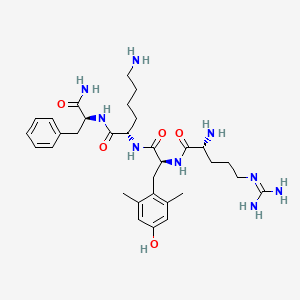
Overview
SS-31 is a fully synthetic, mitochondria-targeted tetrapeptide. Experimental studies examine its interaction with cardiolipin, a lipid in the inner mitochondrial membrane, and its relationship to mitochondrial ATP production.[1]
Published research
Biochemical study · Cardiolipin and cytochrome c
Cytochrome c normally carries electrons. Its interaction with cardiolipin can also favor peroxidase activity. The researchers found that SS-31 preserved cytochrome c’s electron-carrier function in the presence of cardiolipin and supported mitochondrial ATP synthesis in their experimental systems.[1]
Animal study · Age as a comparator
In mouse skeletal muscle, researchers measured ATP production and the coupling of oxygen consumption to ATP synthesis. The reported response to SS-31 was apparent in aged muscle, with no observable effect in the young comparison group. SS-31 restored the measured ATP-production and coupling indices in aged mouse muscle toward young-mouse levels, while young muscle showed no observable response.[2]
Dosing
Research doses
| Study | Model | Dose | Route | Duration |
|---|---|---|---|---|
| Siegel et al., Aging Cell, 2013 | Young (5-month) and old (27-month) mice | 3 mg/kg | Intraperitoneal · A single injection for the one-hour measurement | Energetics measured 1 hour later. The abstract also says eight days of treatment increased endurance, without restating the daily dose for that arm. |
| Karaa et al., Neurology, 2023 (MMPOWER-3) | 218 people with genetically confirmed primary mitochondrial myopathy | 40 mg/day | Subcutaneous · Daily | 24 weeks |
| Forzinity (elamipretide) prescribing information, DailyMed, revised 2025 | Labeled use in patients with Barth syndrome weighing at least 30 kg | 40 mg once daily; 20 mg once daily in adults with eGFR below 30 mL/min who are not on dialysis | Subcutaneous · Once daily | The label does not set a stop date. Approval is accelerated, based on knee-extensor strength, and may require a confirmatory trial. |
Side effects reported in studies
Names below are adverse findings stated in the cited studies, or, when at least 10 independent firsthand reports name them, a count from those reports. They are not a complete list and not guidance for human use.
None named in the studies cited on this page.
Anecdotal / user experience
Reported dose ranges
Insufficient reports from the PeptiRef firsthand sample (fewer than 10).
Commonly cited community protocol — source: Peptide Dosing Protocols (peptidedosingprotocols.com). Accessed 29 November 2026. Source page
| Amount listed | Frequency listed | Duration listed | Route listed |
|---|---|---|---|
| 40 mg (20 mg where the label adjusts for severe renal impairment) | Once daily | The label row does not set a stop date; a cited trial used 12-week periods and a longer open-label extension | Subcutaneous, as listed for the Forzinity product |
| Community pages summarized there cluster around 1–5 mg, 5–10 mg, or 10–20 mg per day | Daily, in that summary | Not given as one length | Described as separate from the 40 mg label dose |
Reported effects
Retrieval on 29 Nov 2026 from the Arctic Shift archive of public r/Peptides submissions (search limit 20–40 posts per compound query). A report was counted only when the text was a firsthand description of something the author had already noticed, the compound was a subject of that description, and the post was not a dosing compilation, a how-to, or a statement of future plans. One post was counted once, on the compound it was about. Posts that only described a blend were not split into ingredient counts. Compilations were excluded. A percentage is shown only when 10 or more reports met those rules.
Insufficient reports.
Commonly self-reported side effects
Insufficient reports. Peptide Dosing Protocols did not list discrete side-effect names for SS-31 on the page reviewed.
Frequently asked questions
Why is cardiolipin important in SS-31 research?
Cardiolipin is a special lipid in the inner mitochondrial membrane. It helps support the machinery involved in energy production. Researchers study how SS-31 interacts with that membrane environment.[1]
What does ATP production tell scientists about SS-31?
Did SS-31 produce the same result in young and older mice?
In the cited muscle study, ATP production and energy coupling changed in aged mice, while no detectable response was reported in the young comparison group. The starting condition mattered.[2]
Is SS-31 studied for the same reason as MOTS-c?
Is FDA-approved elamipretide the same as research-grade SS-31?
SS-31 is a research name for elamipretide. In 2025 the FDA granted accelerated approval to the specific prescription product Forzinity for certain patients with Barth syndrome. That approval does not extend to other elamipretide materials or to other proposed uses.[3]