Identity
| Length | 16 amino-acid residues |
|---|---|
| Reported coding region | Mitochondrial 12S rRNA region |
| Reference compound | MOTS-c (free base) |
| CAS number | 1627580-64-6 |
| Molecular formula | C101H152N28O22S2 |
| Molecular weight | 2174.6 g/mol |
| Source | PubChem CID 146675088 · FDA reference |
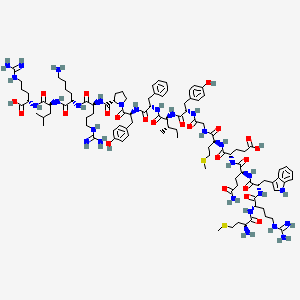
Overview
MOTS-c is a naturally occurring 16-amino-acid peptide encoded within the mitochondrial 12S rRNA region. Research examines how it relates to cellular energy metabolism and insulin sensitivity in experimental models.[1]
Published research
Cell and mouse study · Metabolic signaling
Lee and colleagues traced changes in folate and purine metabolism and examined AMPK, an energy-sensitive signaling enzyme. In high-fat-fed mice, the authors reported differences in weight gain and insulin sensitivity. The authors linked inhibition of folate and purine metabolism to AMPK activation in cells and found that MOTS-c prevented diet-induced insulin resistance in the mice studied.[1]
Cell study · Movement from mitochondria to nucleus
A subsequent study found that metabolic stress was associated with AMPK-dependent movement of MOTS-c into the nucleus. Under glucose restriction, investigators observed interactions with stress-responsive transcription factors including NRF2 and changes in genes associated with antioxidant response elements. The researchers found that metabolic stress triggered AMPK-dependent movement of MOTS-c into the nucleus, where it interacted with NRF2 and regulated stress-responsive genes.[2]
Dosing
Research doses
The 2015 mouse paper already cited on this page (PMID 25738459) does not state a milligram-per-kilogram dose in the open abstract. A later dystrophic-mouse paper (PMID 33337582) says MOTS-c 500 µg was given with an oligonucleotide, without stating micrograms per kilogram or the route in the abstract, so that figure is not entered as a dose row.
| Study | Model | Dose | Route | Duration |
|---|---|---|---|---|
| Kumagai et al., American Journal of Physiology, 2024 | Male C57BL/6J mice, 10 weeks old, with one hindlimb casted | 15 mg/kg/day | Injection; the abstract does not say intraperitoneal or subcutaneous · Daily | 8 days |
Side effects reported in studies
Names below are adverse findings stated in the cited studies, or, when at least 10 independent firsthand reports name them, a count from those reports. They are not a complete list and not guidance for human use.
None named in the studies cited on this page.
Anecdotal / user experience
Reported dose ranges
Insufficient reports from the PeptiRef firsthand sample (fewer than 10).
Commonly cited community protocol — source: Peptide Dosing Protocols (peptidedosingprotocols.com). Accessed 29 November 2026. Source page
| Amount listed | Frequency listed | Duration listed | Route listed |
|---|---|---|---|
| 5–10 mg | 2–3 times weekly | About 4–8 weeks on the chart row | Subcutaneous, as listed |
Reported effects
Retrieval on 29 Nov 2026 from the Arctic Shift archive of public r/Peptides submissions (search limit 20–40 posts per compound query). A report was counted only when the text was a firsthand description of something the author had already noticed, the compound was a subject of that description, and the post was not a dosing compilation, a how-to, or a statement of future plans. One post was counted once, on the compound it was about. Posts that only described a blend were not split into ingredient counts. Compilations were excluded. A percentage is shown only when 10 or more reports met those rules.
Insufficient reports.
Commonly self-reported side effects
PeptiRef’s firsthand sample is under 10, so no share is calculated. The names below are listed by Peptide Dosing Protocols. Accessed 29 November 2026. Source page
- Injection-site redness Peptide Dosing Protocols, accessed 29 November 2026
- Swelling Peptide Dosing Protocols, accessed 29 November 2026
- Flushing or skin warmth Peptide Dosing Protocols, accessed 29 November 2026
- Mild fatigue Peptide Dosing Protocols, accessed 29 November 2026
- Headache Peptide Dosing Protocols, accessed 29 November 2026
- Heart palpitations Peptide Dosing Protocols, accessed 29 November 2026
- Insomnia Peptide Dosing Protocols, accessed 29 November 2026
- Fever Peptide Dosing Protocols, accessed 29 November 2026
Frequently asked questions
Why is MOTS-c described as a mitochondria-derived peptide?
MOTS-c is a 16-amino-acid peptide encoded in a region of mitochondrial DNA. Most familiar cell proteins are encoded by DNA in the nucleus. Its unusual genetic origin does not establish the safety of a synthetic research material.[1]
What does AMPK have to do with MOTS-c?
Why would a mitochondrial peptide move into the nucleus?
The nucleus contains most of a cell’s genetic instructions. Researchers observed MOTS-c moving there during metabolic stress, where it interacted with proteins that help control stress-related genes.[2]
What did the MOTS-c mouse study measure?
The researchers examined metabolism in mice, including how the animals responded to insulin under a high-fat diet. The results describe that model, not a human weight-loss or exercise outcome.[1]