Identity
| Sequence | Ala–Glu–Asp–Gly |
|---|---|
| Length | 4 amino-acid residues |
| Reference compound | Epithalon |
| CAS number | 307297-39-8 |
| Molecular formula | C14H22N4O9 |
| Molecular weight | 390.35 g/mol |
| Source | PubChem CID 219042 |
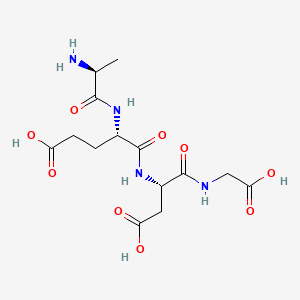
Overview
Epithalon, also spelled Epitalon, is a tetrapeptide first synthesized based on the amino acid composition of a pineal gland extract. Cell-culture studies examine telomerase activity and telomere length.[1]
Published research
Cell study · Telomerase and telomere length
Khavinson and colleagues studied human fetal fibroblasts in culture. They detected telomerase activity after peptide exposure and measured an increase in telomere length. In initially telomerase-negative human fetal fibroblasts, the authors detected expression of the catalytic telomerase subunit, measurable enzyme activity and longer telomeres after Epithalon exposure.[1]
Comparative cell study · Two routes to telomere maintenance
A 2025 study compared several human cell lines and examined hTERT expression, enzyme activity and markers of alternative lengthening of telomeres (ALT). The authors reported that the route associated with lengthening varied by cell model. The authors found telomere lengthening associated with increased telomerase activity in normal cultured cells and with activation of alternative lengthening of telomeres in the two breast cancer cell lines.[2]
Analytical study · Origin of the sequence
A separate investigation reported detecting the four-residue AEDG sequence in a pineal peptide preparation. That addresses chemical occurrence, a different question from what the isolated synthetic peptide does in cultured cells. Using chromatography and mass spectrometry, the researchers identified the AEDG tetrapeptide in the pineal extract they analyzed.[3]
Dosing
Research doses
The human fetal-fibroblast paper already cited here (PMID 12937682) reports telomerase induction. Its open abstract does not state the concentration, so it is not given a dose row.
| Study | Model | Dose | Route | Duration |
|---|---|---|---|---|
| Yue et al., Aging, 2022 | Mouse oocytes aging in culture after ovulation | 0.1 mmol/L in the culture medium | Added to the medium · Present during culture | Oocytes assessed at 6, 12, and 24 hours |
Side effects reported in studies
Names below are adverse findings stated in the cited studies, or, when at least 10 independent firsthand reports name them, a count from those reports. They are not a complete list and not guidance for human use.
None named in the studies cited on this page.
Anecdotal / user experience
Reported dose ranges
Insufficient reports from the PeptiRef firsthand sample (fewer than 10).
Commonly cited community protocol — source: Peptide Dosing Protocols (peptidedosingprotocols.com). Accessed 29 November 2026. Source page
| Amount listed | Frequency listed | Duration listed | Route listed |
|---|---|---|---|
| 5 mg per day, or 10 mg per day | Once daily, in the evening, as listed | 20 days at 5 mg, or 10 days at 10 mg, about 2–3 times a year | Subcutaneous, as listed |
Reported effects
Retrieval on 29 Nov 2026 from the Arctic Shift archive of public r/Peptides submissions (search limit 20–40 posts per compound query). A report was counted only when the text was a firsthand description of something the author had already noticed, the compound was a subject of that description, and the post was not a dosing compilation, a how-to, or a statement of future plans. One post was counted once, on the compound it was about. Posts that only described a blend were not split into ingredient counts. Compilations were excluded. A percentage is shown only when 10 or more reports met those rules.
Insufficient reports.
Commonly self-reported side effects
PeptiRef’s firsthand sample is under 10, so no share is calculated. The names below are listed by Peptide Dosing Protocols. Accessed 29 November 2026. Source page
- Headache Peptide Dosing Protocols, accessed 29 November 2026
- Temporary sleep change Peptide Dosing Protocols, accessed 29 November 2026
Frequently asked questions
Is Epithalon (Epitalon) the same thing as a pineal gland extract?
No. Epithalon, also spelled Epitalon, is a defined four-amino-acid peptide with the sequence AEDG. A gland extract can contain many molecules. Researchers reported detecting the AEDG sequence in a particular pineal preparation.[3]
Why are telomeres studied with Epithalon?
Is longer telomere length the same as higher telomerase activity?
Did normal cells and cancer cell lines respond in the same way?
A 2025 study reported longer telomeres in both types of cultured cells. Normal cell models showed greater telomerase activity, while two cancer cell lines mainly used a different telomere-maintenance process called ALT.[2]