Identity
| Compound class | Synthetic ACTH-fragment analog |
|---|---|
| Length | 7 amino-acid residues |
| Reference compound | Semax |
| CAS number | 80714-61-0 |
| Molecular formula | C37H51N9O10S |
| Molecular weight | 813.9 g/mol |
| Source | PubChem CID 9811102 |
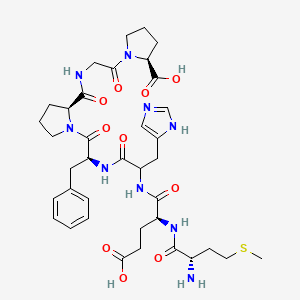
Overview
Semax is a synthetic seven-amino-acid analogue based on a fragment of the naturally occurring hormone ACTH. Preclinical research examines cortical gene expression after experimental brain ischemia.[1]
Published research
Animal study · Protein abundance
Dolotov and colleagues studied Semax binding and measured BDNF protein in rat basal forebrain. A regional tissue measurement captures the combined signal of the cells in that sample. Dolotov and colleagues found specific Semax binding and increased BDNF protein in rat basal forebrain.[1]
Animal study · Gene expression after ischemia
In a rat focal-ischemia model, investigators compared cortical gene expression with that of ischemia controls. Differences involved groups of genes linked to immune responses and vascular processes. Compared with ischemic controls, Semax-exposed rats showed changes in immune- and vascular-related gene expression, with prominent increases in immunoglobulin and cytokine transcripts at 24 hours.[2]
Dosing
Research doses
| Study | Model | Dose | Route | Duration |
|---|---|---|---|---|
| Dolotov et al., Journal of Neurochemistry, 2006 | Rats | 50 µg/kg and 250 µg/kg | Intranasal · A single application | BDNF measured 3 hours later |
| Volodina et al., Bulletin of Experimental Biology and Medicine, 2012 | Adolescent white rats after daily maternal separation on postnatal days 1–14 | 0.05 mg/kg | Intranasal · Daily | Postnatal days 15 through 28 |
| Serdiuk et al., Zhurnal Nevrologii i Psikhiatrii, 2007 | 27 patients with motor neuron disease | 12 mg/day of a 1% solution | Intranasal · Daily during each course | Two 10-day courses separated by 2 weeks |
Side effects reported in studies
Names below are adverse findings stated in the cited studies, or, when at least 10 independent firsthand reports name them, a count from those reports. They are not a complete list and not guidance for human use.
None named in the studies cited on this page.
Anecdotal / user experience
Reported dose ranges
Insufficient reports from the PeptiRef firsthand sample (fewer than 10).
Commonly cited community protocol — source: Peptide Dosing Protocols (peptidedosingprotocols.com). Accessed 29 November 2026. Source page
| Amount listed | Frequency listed | Duration listed | Route listed |
|---|---|---|---|
| 0.6–1.5 mg per day | Split into 2 administrations | Not given as one cycle length on the chart; some signals on the page are described over about 2–4 weeks | Nasal, as listed; subcutaneous is described as less common |
Reported effects
Retrieval on 29 Nov 2026 from the Arctic Shift archive of public r/Peptides submissions (search limit 20–40 posts per compound query). A report was counted only when the text was a firsthand description of something the author had already noticed, the compound was a subject of that description, and the post was not a dosing compilation, a how-to, or a statement of future plans. One post was counted once, on the compound it was about. Posts that only described a blend were not split into ingredient counts. Compilations were excluded. A percentage is shown only when 10 or more reports met those rules.
Insufficient reports.
Commonly self-reported side effects
PeptiRef’s firsthand sample is under 10, so no share is calculated. The names below are listed by Peptide Dosing Protocols. Accessed 29 November 2026. Source page
- Nasal cavity discoloration Peptide Dosing Protocols, accessed 29 November 2026
- Nasal irritation Peptide Dosing Protocols, accessed 29 November 2026
- Sneezing Peptide Dosing Protocols, accessed 29 November 2026
- Nasal dryness Peptide Dosing Protocols, accessed 29 November 2026
- Overstimulation or anxiety Peptide Dosing Protocols, accessed 29 November 2026
- Sleep disruption Peptide Dosing Protocols, accessed 29 November 2026
Frequently asked questions
Is Semax the same as the hormone ACTH?
No. Semax is a synthetic seven-amino-acid peptide based on part of ACTH. It is not the full-length hormone, so the activity of ACTH cannot simply be assigned to it.[1]
What is BDNF, and why is it mentioned in Semax research?
BDNF is a protein involved in nerve-cell growth and function. The cited rat study measured BDNF protein in basal forebrain tissue and reported an increase after Semax exposure.[1]
Does a change in BDNF prove better memory or learning?
No. A protein measurement in rat brain tissue is not a direct test of memory, learning or mental performance in people.[1]
Why did the Semax rat brain study look at immune and blood vessel genes?
The study used a rat model of ischemia, or reduced blood flow. Both immune and blood vessel systems respond when brain tissue is under stress. The authors observed changes in related gene groups; that does not establish protection or recovery in people.[2]