Identity
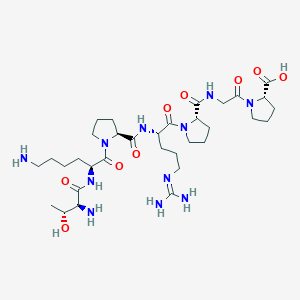
| Compound class | Synthetic heptapeptide |
|---|---|
| Length | 7 amino-acid residues |
| Reference compound | Selank |
| CAS number | 129954-34-3 |
| Molecular formula | C33H57N11O9 |
| Molecular weight | 751.9 g/mol |
| Source | PubChem CID 11765600 |
Overview
Selank is a synthetic seven-amino-acid analogue of the naturally occurring peptide tuftsin. Preclinical research examines gene expression associated with GABA and dopamine signaling.[1]
Published research
Animal study · Neurotransmission-related transcripts
Researchers measured selected messenger RNAs in rat frontal cortex after Selank exposure. They reported changes in transcripts associated with GABA-receptor subunits and dopamine receptors. The researchers found correlated changes in neurotransmission-related gene expression after Selank and GABA exposure in rat frontal cortex, supporting their hypothesis that GABAergic signaling contributes to Selank’s effects.[1]
Selank and GABA receptor interactions
A binding assay tested whether Selank altered the interaction of labeled GABA with receptors in brain-cell membrane preparations. The authors interpreted changes in labeled GABA binding in membrane preparations as evidence that Selank can modulate GABA binding allosterically.[2]
Selank and BDNF in a rat ethanol-exposure model
A second group used a chronic ethanol-exposure model to compare brain-derived neurotrophic factor (BDNF) and object recognition during withdrawal. In the chronic ethanol-exposure rat model, researchers found that Selank prevented the rise in hippocampal and frontal-cortex BDNF and attenuated the recognition-memory disturbance observed during withdrawal.[3]
Dosing
Research doses
A human anxiety study (PMID 18454096) compared Selank with medazepam but does not state the Selank dose in the open abstract.
| Study | Model | Dose | Route | Duration |
|---|---|---|---|---|
| Kolik et al., Bulletin of Experimental Biology and Medicine, 2019 | Outbred rats, including animals given 10% ethanol as their only fluid for 30 weeks | 0.3 mg/kg (300 µg/kg) | Intraperitoneal · Once daily | 7 days |
| Volkova et al., Frontiers in Pharmacology, 2016 | Rat frontal cortex | 300 µg/kg | Not stated in the open abstract · A single administration | Gene expression measured at 1 hour and 3 hours |
Side effects reported in studies
Names below are adverse findings stated in the cited studies, or, when at least 10 independent firsthand reports name them, a count from those reports. They are not a complete list and not guidance for human use.
None named in the studies cited on this page.
Anecdotal / user experience
Reported dose ranges
Insufficient reports from the PeptiRef firsthand sample (fewer than 10).
Commonly cited community protocol — source: Peptide Dosing Protocols (peptidedosingprotocols.com). Accessed 29 November 2026. Source page
| Amount listed | Frequency listed | Duration listed | Route listed |
|---|---|---|---|
| 250–500 mcg | Once daily | About 4 weeks, then about 4 weeks off, as listed for the subcutaneous schedule | Subcutaneous, as listed |
| 600–2,700 mcg per day | Split across 2–3 administrations | About 14–21 days, then 1–3 weeks off, as listed for the nasal schedule | Nasal, as listed |
Reported dose progression
Commonly cited community protocol — source: Peptide Dosing Protocols (peptidedosingprotocols.com). Accessed 29 November 2026. Source page. The phases are the steps that page lists. They are not a recommendation and not for human use.
| Phase / week | Amount as listed | Frequency | Notes |
|---|---|---|---|
| Initiation, weeks 1–2 | 250–300 mcg | Once daily | Subcutaneous cycle outline. Listed as a baseline check. |
| Maintenance, weeks 3–4 | 400–500 mcg | Once daily | Same subcutaneous outline. Listed as a step up from the lower amount. |
| Cycle off, weeks 5–8 | 0 mcg | None listed | Same subcutaneous outline. Listed as a four-week rest. |
| Repeat, weeks 9–12 | 300–500 mcg | Once daily | Same subcutaneous outline. Listed as a return in this range. |
Reported effects
Retrieval on 29 Nov 2026 from the Arctic Shift archive of public r/Peptides submissions (search limit 20–40 posts per compound query). A report was counted only when the text was a firsthand description of something the author had already noticed, the compound was a subject of that description, and the post was not a dosing compilation, a how-to, or a statement of future plans. One post was counted once, on the compound it was about. Posts that only described a blend were not split into ingredient counts. Compilations were excluded. A percentage is shown only when 10 or more reports met those rules.
Insufficient reports.
Commonly self-reported side effects
Insufficient reports. Peptide Dosing Protocols did not list discrete side-effect names for Selank on the page reviewed.
Frequently asked questions
Why do researchers compare Selank with the signaling molecule GABA?
Does Selank bind GABA receptors in the same way as GABA itself?
The cited binding study suggested an allosteric effect, meaning a change in how another molecule binds. It did not establish that Selank works exactly like GABA.[2]
Why do some Selank studies measure dopamine receptor genes?
The rat study examined several genes linked to nerve-cell communication, including genes related to dopamine receptors. A change in gene activity is not proof that dopamine levels changed.[1]
What did the Selank and BDNF study actually examine?
It used a rat model involving chronic ethanol exposure and withdrawal. Scientists measured a brain protein called BDNF and object recognition. Those results are specific to that model.[3]