Identity
| Compound class | Peptide |
|---|---|
| Length | 9 amino-acid residues |
| Reference compound | DSIP (emideltide) |
| CAS number | 62568-57-4 |
| Molecular formula | C35H48N10O15 |
| Molecular weight | 848.8 g/mol |
| Source | PubChem CID 68816 |
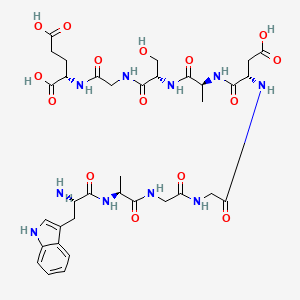
Overview
Delta sleep-inducing peptide (DSIP) is a naturally occurring nine-amino-acid peptide first isolated from rabbit blood dialysate. Experimental sleep research examines slow-wave EEG activity and motor activity in rabbits.[1]
Published research
DSIP rabbit EEG and motor-activity experiments
By recording EEG and movement simultaneously, the team could compare a slow-wave electrical signal with a behavioral measure. The investigators found increased delta EEG activity in freely moving rabbits within five hours, accompanied by a slight decrease in movement.[1]
DSIP and delta and spindle EEG patterns
A separate rabbit study distinguished two features of the EEG record: slow delta waves and spindle activity. The investigators reported that the peptide induced both delta and spindle EEG activity in rabbits.[2]
Review · Why the name is an incomplete description
A critical review revisited the relationship between the original electrophysiological observations and later proposals for an endogenous sleep mechanism. A peptide sequence, an EEG response in one animal model and a defined physiological signaling pathway are different kinds of evidence. The reviewers concluded that the evidence available at the time had not established a single physiological mechanism that explained DSIP’s reported sleep effects.[3]
Dosing
Research doses
The doses below are the papers’ own units (nanomoles per kilogram). They are not converted into a milligram human dose.
| Study | Model | Dose | Route | Duration |
|---|---|---|---|---|
| Schneider-Helmert et al., International Journal of Clinical Pharmacology, 1981 | Six healthy volunteers in a double-blind crossover | 25 nmol/kg | Slow intravenous infusion · Once, in the morning | Sleep was counted over the next 130 minutes; later-night sleep was also recorded |
| Schneider-Helmert, European Neurology, 1984 | People with insomnia, across the investigations summarized in the paper | 25 nmol/kg | Injection; the abstract does not further specify the route · Single injections before sleep, and separate tests of repeated administration | The abstract says sleep structure was described as normalized after four administrations. Two doses in one day did not help night sleep. |
Side effects reported in studies
Names below are adverse findings stated in the cited studies, or, when at least 10 independent firsthand reports name them, a count from those reports. They are not a complete list and not guidance for human use.
- None observed Schneider-Helmert 1981, six volunteers, one infusion
Anecdotal / user experience
Reported dose ranges
Insufficient reports from the PeptiRef firsthand sample (fewer than 10).
Commonly cited community protocol — source: Peptide Dosing Protocols (peptidedosingprotocols.com). Accessed 29 November 2026. Source page
| Amount listed | Frequency listed | Duration listed | Route listed |
|---|---|---|---|
| 100–300 mcg | Once, in the evening | Described as a short cycle; one supply example uses about 4 weeks | Subcutaneous, as listed |
Reported effects
Retrieval on 29 Nov 2026 from the Arctic Shift archive of public r/Peptides submissions (search limit 20–40 posts per compound query). A report was counted only when the text was a firsthand description of something the author had already noticed, the compound was a subject of that description, and the post was not a dosing compilation, a how-to, or a statement of future plans. One post was counted once, on the compound it was about. Posts that only described a blend were not split into ingredient counts. Compilations were excluded. A percentage is shown only when 10 or more reports met those rules.
Insufficient reports.
Commonly self-reported side effects
PeptiRef’s firsthand sample is under 10, so no share is calculated. The names below are listed by Peptide Dosing Protocols. Accessed 29 November 2026. Source page
- Mild headache Peptide Dosing Protocols, accessed 29 November 2026
- Nausea Peptide Dosing Protocols, accessed 29 November 2026
- Dizziness Peptide Dosing Protocols, accessed 29 November 2026
- Morning sluggishness Peptide Dosing Protocols, accessed 29 November 2026
- Vivid dreams Peptide Dosing Protocols, accessed 29 November 2026
Frequently asked questions
Why is DSIP called delta sleep-inducing peptide?
What did the original DSIP rabbit experiments measure?
Researchers recorded brain electrical activity and, in one study, movement. They reported changes in slow-wave activity along with a small decrease in movement.[1]
What is the difference between delta waves and sleep spindles?
Delta waves are slow brain-wave patterns. Sleep spindles are brief bursts of faster activity. The cited rabbit experiment observed both patterns after exposure to DSIP.[2]
Do changes in rabbit delta waves establish better sleep or an insomnia treatment?
Has a single natural sleep mechanism for DSIP been established?
The cited critical review concluded that the evidence had not established one mechanism that explains the reported sleep effects. The name alone cannot resolve that question.[3]