Identity
| Material class | Multi-compound blend |
|---|---|
| Components | GHK-Cu, BPC-157, Thymosin Beta-4, KPV |
| CAS number | See individual components |
| Molecular formula | See individual components |
| Molecular weight | See individual components |
| Reference compound | GHK-Cu (neutral 1:1 prezatide copper complex) |
|---|---|
| CAS number | 89030-95-5 |
| Molecular formula | C14H22CuN6O4 |
| Molecular weight | 401.91 g/mol |
| Source | PubChem CID 10111685 |
| Reference compound | BPC-157 |
|---|---|
| CAS number | 137525-51-0 |
| Molecular formula | C62H98N16O22 |
| Molecular weight | 1419.5 g/mol |
| Source | PubChem CID 9941957 |
| Reference compound | Thymosin Beta-4 (full-length peptide) |
|---|---|
| CAS number | 77591-33-4 |
| Molecular formula | C212H350N56O78S |
| Molecular weight | 4963 g/mol |
| Source | PubChem CID 45382195 · CAS cross-reference |
| Reference compound | KPV |
|---|---|
| CAS number | 67727-97-3 |
| Molecular formula | C16H30N4O4 |
| Molecular weight | 342.43 g/mol |
| Source | PubChem CID 125672 |

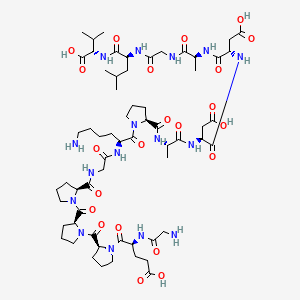


Overview
KLOW contains GHK-Cu, BPC-157, full-length Thymosin Beta-4 (TB4), and KPV. GHK-Cu is studied for collagen synthesis and MMP-2 expression in fibroblast cultures.[1]
Published research
Each finding on this page is from a study of one ingredient, not from a study of the finished KLOW blend.
GHK-Cu
The copper complex is the constituent examined in the matrix studies. Collagen synthesis measures the production of new protein. MMP-2 and its inhibitors concern the machinery that remodels existing material. These endpoints can change together, so more collagen synthesis in a dish does not reveal the net amount retained in tissue. A study that also included hyaluronic acid tested a different formulation from this blend.
Cell study · Matrix production
GHK-Cu increased collagen synthesis in cultured fibroblasts independently of changes in cell number.[1]
Cell study · Matrix turnover
The researchers found increased MMP-2 and its inhibitors TIMP-1 and TIMP-2, supporting a role for GHK-Cu in matrix remodeling as well as matrix production.[2]
Read the full GHK-Cu overviewBPC-157
The BPC-157 work separates three processes that might otherwise look similar in an explant: cells can move farther, more cells can survive, or cells can become more responsive to another signal. The original experiments used tendon-derived material. Their findings identify properties of BPC-157 in those preparations and provide no direct measurement of how the other ingredients affect those properties.
Cell and explant study · Migration versus survival
In rat tendon explants and fibroblast cultures, BPC-157 increased cell outgrowth, migration and survival during oxidative stress, with migration accompanied by activation of FAK and paxillin.[3]
Cell study · Growth hormone receptor expression
The researchers found more growth hormone receptor RNA and protein after BPC-157 exposure. Adding growth hormone to the pretreated fibroblasts increased proliferation-associated readouts and activated JAK2.[4]
Read the full BPC-157 overviewThymosin Beta-4
KLOW contains the full-length chain. This matters because the binding study identified more than one region that contributes to the interaction with actin. A short central fragment cannot stand in for the full-length molecule in interpreting those experiments. The tissue studies add another level of evidence by measuring events in intact rat wounds. They did not test the other KLOW constituents alongside thymosin beta-4.
Biochemical study · How the chain binds actin
The investigators found actin-interacting residues in both the N-terminal region and the central six-residue motif of full-length thymosin beta-4.[5]
Rat skin-wound study
Compared with saline controls, treated rat wounds showed 42% greater re-epithelialization on day four, alongside increased collagen deposition and new vessel formation.[6]
Read the full Thymosin Beta-4 overviewKPV
KPV is the three-residue constituent of KLOW. Its epithelial-cell studies asked how a small peptide enters a cell and how that cell responds to an inflammatory stimulus. A transporter result concerns entry, whereas nuclear movement of a signaling protein concerns what happens inside the cell. The distinction matters when comparing the intestinal and bronchial experiments or interpreting their relevance to a mixture.
Cell and animal study · Uptake and inflammatory signaling
The investigators found that PepT1 transported KPV into cells, where it reduced inflammatory signaling and cytokine release, and reported reduced intestinal inflammation in mouse models.[7]
Cell study · A second epithelial model
The authors found that KPV interfered with nuclear entry of the NF-κB subunit p65 and reduced inflammatory signaling in stimulated bronchial epithelial cells.[8]
Read the full KPV overviewDosing
Research doses
No published study of the four-part KLOW mixture was found. Component doses are on the GHK-Cu, BPC-157, thymosin β4, and KPV pages. They are not a dose of the mixture.
No sourced study dose was found for KLOW.
Side effects reported in studies
Names below are adverse findings stated in the cited studies, or, when at least 10 independent firsthand reports name them, a count from those reports. They are not a complete list and not guidance for human use.
None named in the studies cited on this page.
Anecdotal / user experience
Reported dose ranges
Insufficient reports from the PeptiRef firsthand sample (fewer than 10).
Commonly cited community protocol — source: Peptide Dosing Protocols (peptidedosingprotocols.com). Accessed 29 November 2026. Source page
| Amount listed | Frequency listed | Duration listed | Route listed |
|---|---|---|---|
| 2–6 mg of the combined blend | Daily | Not stated on the chart row | Subcutaneous, as listed |
Reported effects
Retrieval on 29 Nov 2026 from the Arctic Shift archive of public r/Peptides submissions (search limit 20–40 posts per compound query). A report was counted only when the text was a firsthand description of something the author had already noticed, the compound was a subject of that description, and the post was not a dosing compilation, a how-to, or a statement of future plans. One post was counted once, on the compound it was about. Posts that only described a blend were not split into ingredient counts. Compilations were excluded. A percentage is shown only when 10 or more reports met those rules.
Insufficient reports.
Commonly self-reported side effects
Insufficient reports. Peptide Dosing Protocols did not list discrete side-effect names for KLOW on the page reviewed.
Frequently asked questions
Which ingredients distinguish KLOW from GLOW?
Why is KPV discussed separately in KLOW research?
Why does the full-length thymosin beta-4 chain matter in KLOW?
The cited actin-binding experiment found that multiple parts of the chain contributed to binding. A short TB-500 fragment cannot be treated as the same research material.[5]
Has the four-component KLOW mixture been tested in the cited papers?
References
- GHK-Cu and collagen synthesis in fibroblast cultures | FEBS Lett, 1988
- GHK-Cu and MMP-2 in fibroblast cultures | Life Sci, 2000
- Tendon-cell migration and survival | J Appl Physiol (1985), 2011
- Growth hormone receptor expression in tendon fibroblasts | Molecules, 2014
- Thymosin β4 actin-binding study · 1996
- Rat skin-wound study | J Invest Dermatol, 1999
- KPV transport and intestinal inflammation | Gastroenterology, 2008
- KPV inflammatory signaling in bronchial epithelial cells | Int J Physiol Pathophysiol Pharmacol, 2012