Identity
| Compound class | Synthetic peptide |
|---|---|
| Length | 15 amino-acid residues |
| Reference compound | BPC-157 |
| CAS number | 137525-51-0 |
| Molecular formula | C62H98N16O22 |
| Molecular weight | 1419.5 g/mol |
| Source | PubChem CID 9941957 |
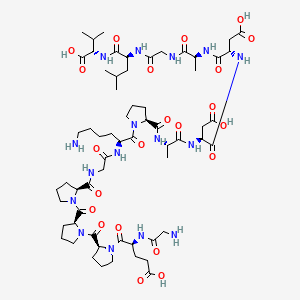
Overview
BPC-157 is a synthetic 15-amino-acid peptide modeled on a reported sequence from a gastric protein. Preclinical research examines tendon-cell migration, outgrowth, and survival under oxidative stress.[1]
Published research
Cell and explant study · Migration versus survival
Investigators measured outgrowth from rat tendon explants and followed individual tendon fibroblasts in culture. They observed greater outgrowth and migration with BPC-157, along with changes in FAK–paxillin signaling, which links cell adhesion to movement. In rat tendon explants and fibroblast cultures, BPC-157 increased cell outgrowth, migration and survival during oxidative stress, with migration accompanied by activation of FAK and paxillin.[1]
Cell study · Growth hormone receptor expression
A later study measured growth hormone receptor expression in tendon fibroblasts after exposure to BPC-157. Receptor abundance gives the cell a possible route to respond differently to a subsequent signal. The researchers found more growth hormone receptor RNA and protein after BPC-157 exposure. Adding growth hormone to the pretreated fibroblasts increased proliferation-associated readouts and activated JAK2.[2]
Dosing
Research doses
The tendon-fibroblast papers already cited on this page (Chang 2011 and Chang 2014) describe concentration-dependent effects. Their open abstracts do not state the concentrations, so those papers are not given a dose row.
| Study | Model | Dose | Route | Duration |
|---|---|---|---|---|
| Cerovecki et al., Journal of Orthopaedic Research, 2010 | Rats after medial collateral ligament transection | 10 µg/kg or 10 ng/kg; or 1.0 µg per gram of cream; or 0.16 µg/mL in drinking water at a stated intake of 12 mL/day per rat | Intraperitoneal, topical cream, or drinking water, each tested alone · Once daily for the injection and cream arms; drinking water until sacrifice | First application 30 minutes after surgery; last application 24 hours before sacrifice; follow-up through 90 days |
| Staresinic et al., Journal of Orthopaedic Research, 2003 | Rats after Achilles tendon transection | 10 µg/kg, 10 ng/kg, or 10 pg/kg | Intraperitoneal · Once daily | Started 30 minutes after surgery; last dose 24 hours before autopsy on day 1, 4, 7, 10, or 14 |
Side effects reported in studies
Names below are adverse findings stated in the cited studies, or, when at least 10 independent firsthand reports name them, a count from those reports. They are not a complete list and not guidance for human use.
None named in the studies cited on this page.
Anecdotal / user experience
Reported dose ranges
Insufficient reports from the PeptiRef firsthand sample (fewer than 10).
Commonly cited community protocol — source: Peptide Dosing Protocols (peptidedosingprotocols.com). Accessed 29 November 2026. Source page
| Amount listed | Frequency listed | Duration listed | Route listed |
|---|---|---|---|
| 250–500 mcg | 1–2 times daily | Examples on the compound page run about 6–12 weeks, with breaks of a few weeks also described | Subcutaneous or oral, as listed |
Reported effects
Retrieval on 29 Nov 2026 from the Arctic Shift archive of public r/Peptides submissions (search limit 20–40 posts per compound query). A report was counted only when the text was a firsthand description of something the author had already noticed, the compound was a subject of that description, and the post was not a dosing compilation, a how-to, or a statement of future plans. One post was counted once, on the compound it was about. Posts that only described a blend were not split into ingredient counts. Compilations were excluded. A percentage is shown only when 10 or more reports met those rules.
Insufficient reports.
Commonly self-reported side effects
PeptiRef’s firsthand sample is under 10, so no share is calculated. The names below are listed by Peptide Dosing Protocols. Accessed 29 November 2026. Source page
- Injection-site redness Peptide Dosing Protocols, accessed 29 November 2026
- Small bumps at the application site Peptide Dosing Protocols, accessed 29 November 2026
Frequently asked questions
What do tendon-cell studies reveal about BPC-157?
The 2011 rat study tracked tendon cells and small pieces of tendon grown outside the body. It examined cell movement, spreading and survival under oxidative stress. These outcomes describe cell behavior, not tendon strength in a person.[1]
Did BPC-157 make tendon cells multiply faster?
Not directly in the 2011 cell experiment. The scientists observed greater movement and survival under oxidative stress, rather than a direct rise in cell multiplication.[1]
What do FAK and paxillin have to do with BPC-157?
These proteins help cells attach to their surroundings and move. The rat tendon-cell study found changes in their activation alongside increased cell movement.[1]
Why do some BPC-157 studies mention growth hormone?
A separate rat tendon-cell experiment found more growth hormone receptors after exposure to BPC-157. The study then measured how those cells responded to growth hormone; it did not show that BPC-157 is growth hormone.[2]