Identity
| Material | Growth hormone-releasing factor analogue |
|---|---|
| Also called | TH9507 |
| Reference compound | Tesamorelin |
| CAS number | 218949-48-5 |
| Molecular formula | C221H366N72O67S |
| Molecular weight | 5136 g/mol |
| Source | PubChem CID 16137828 |
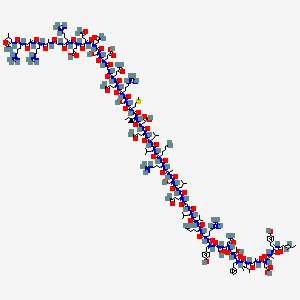
Overview
Tesamorelin (TH9507) is a synthetic analogue of naturally occurring growth hormone-releasing factor. Preclinical research examines peptide stability and growth hormone release.[1]
Published research
Comparative pharmacology · Peptide stability
Researchers compared TH9507 with unmodified growth hormone-releasing factor, examining enzymatic inactivation and growth hormone release. The analogue showed a longer duration of activity in the experimental comparisons. Compared with unmodified growth hormone-releasing factor, TH9507 resisted enzymatic inactivation and degraded more slowly in plasma from rats, dogs and humans.[1]
Human physiology study · Pulse size and basal secretion
Investigators repeatedly sampled growth hormone overnight and used the time series to estimate basal secretion and the size of secretory pulses. They reported increases in basal secretion and average pulse area. From serial overnight measurements, the investigators found that both basal growth hormone secretion and average pulse area increased in the men studied.[2]
Dosing
Research doses
The 2 mg trial dose and the two current labeled doses are different products. The labels say Egrifta WR and Egrifta SV are not substitutable.
| Study | Model | Dose | Route | Duration |
|---|---|---|---|---|
| Russo et al., AIDS, 2024 | People with HIV on integrase-inhibitor regimens, in a randomized placebo-controlled trial | 2 mg once daily | The abstract does not restate the route · Once daily | 12 months |
| Egrifta SV prescribing information, DailyMed | Labeled use for excess abdominal fat in adults with HIV-associated lipodystrophy; 2 mg vial formulation | 1.4 mg (0.35 mL of the reconstituted solution) | Subcutaneous, into the abdomen, rotating sites · Once daily | The label does not set a fixed stop date. A separate review of the earlier trials (PMID 22050344) reported that visceral fat fell over 26 weeks and returned after the drug was stopped. |
| Egrifta WR prescribing information, DailyMed | Same labeled indication; 11.6 mg vial formulation | 1.28 mg (0.16 mL of the reconstituted solution) | Subcutaneous, into the abdomen, rotating sites · Once daily | One mixed vial is labeled for 7 daily doses, then discarded |
Side effects reported in studies
Names below are adverse findings stated in the cited studies, or, when at least 10 independent firsthand reports name them, a count from those reports. They are not a complete list and not guidance for human use.
- Injection-site reactions Tesamorelin review of the 26-week trials
- Arthralgia Tesamorelin review of the 26-week trials
- Headache Tesamorelin review of the 26-week trials
- Peripheral edema Tesamorelin review of the 26-week trials
- Liver findings Dogs, repeat high dose
- Kidney findings Dogs, repeat high dose
- Anaemia Dogs, repeat high dose
Anecdotal / user experience
Reported dose ranges
Insufficient reports from the PeptiRef firsthand sample (fewer than 10).
Commonly cited community protocol — source: Peptide Dosing Protocols (peptidedosingprotocols.com). Accessed 29 November 2026. Source page
| Amount listed | Frequency listed | Duration listed | Route listed |
|---|---|---|---|
| 1.28–2 mg | Once daily | Trial follow-up described on the page runs about 26–52 weeks | Subcutaneous, as listed; the chart attributes the range to the Egrifta labels |
Reported effects
Retrieval on 29 Nov 2026 from the Arctic Shift archive of public r/Peptides submissions (search limit 20–40 posts per compound query). A report was counted only when the text was a firsthand description of something the author had already noticed, the compound was a subject of that description, and the post was not a dosing compilation, a how-to, or a statement of future plans. One post was counted once, on the compound it was about. Posts that only described a blend were not split into ingredient counts. Compilations were excluded. A percentage is shown only when 10 or more reports met those rules.
Insufficient reports.
Commonly self-reported side effects
PeptiRef’s firsthand sample is under 10, so no share is calculated. The names below are listed by Peptide Dosing Protocols. Accessed 29 November 2026. Source page
- Injection-site reactions Peptide Dosing Protocols, accessed 29 November 2026
- Fluid retention Peptide Dosing Protocols, accessed 29 November 2026
- Joint pain Peptide Dosing Protocols, accessed 29 November 2026
- Muscle aches Peptide Dosing Protocols, accessed 29 November 2026
- Blood sugar changes Peptide Dosing Protocols, accessed 29 November 2026
- Antibody development Peptide Dosing Protocols, accessed 29 November 2026
Frequently asked questions
Is tesamorelin the same as growth hormone?
Why was tesamorelin designed as a modified peptide?
Researchers compared it with the original releasing factor to study how easily enzymes break it down. The cited laboratory study found that tesamorelin was more resistant to breakdown.[1]
Did tesamorelin change the size of growth hormone pulses or the release between them?
Growth hormone is released in bursts called pulses. Repeated samples in the cited study of men showed changes in pulse size and increased release between pulses. These hormone patterns are not a direct measure of broader clinical outcomes.[2]
How does tesamorelin differ from GHRP-6?
Tesamorelin is a modified growth hormone-releasing factor, whereas GHRP-6 is a synthetic six-amino-acid releasing peptide. They are distinct molecules even though both are studied in relation to growth hormone.[1]
Does FDA approval of a tesamorelin prescription product cover research-grade tesamorelin?
No. Specific prescription products have FDA approval for a defined indication related to HIV-associated lipodystrophy. That approval does not extend to other tesamorelin materials or establish approval for other uses.[3]